
 The coaching profession has significantly evolved since I participated in my first coaching education program in 1998. In my first decade as a professionally trained coach, it was made clear that coaching and therapy are two different professions, and have different outcomes.
As emotional intelligence and ‘coaching the whole person’ became more popular, the line between therapy and coaching began to overlap. At the same time, therapists were embracing the field of coaching, recognizing that coaching is often a natural evolution for a therapy client who has moved from resolution to living more fully in the present, and now able to consider what’s next for them.
Many coaches who participate in my MCC and PCC mentor coaching programs have training in therapeutic modalities. These coaches are clear when they are coaching and when they are a therapist, and offer them as separate sessions because they are aware that therapy and coaching serve different purposes.
A caveat: I’m not an expert on all the types of therapies that are offered now. Nor on the range of coaching specialties such as cognitive behavioral coaching, trauma recovery coaching, or internal family systems coaching. Rather, this article is about recognizing the boundaries of our professional training and expertise, and when a coaching client may need more than coaching.
Coaching and Psychotherapy Basics
 The fundamental coaching model is where is the client Now, where do they want to be (Then), and what’s in “The Gap” between Now and Then. Coaching can support clarifying Now, Then, and The Gap. The intent is to take congruent action that closes The Gap to move toward desired future outcomes. The future is defined by the client and can be tomorrow, next week, next month or in the next decade.
Counseling is generally a short-term, goal-oriented process focusing on specific, present-day issues like grief or career changes. Psychotherapy is often long-term, aiming to explore deep-seated emotional patterns, past experiences, and complex mental health conditions like depression or trauma to create lasting change.
Whether Counseling or Psychotherapy, the desired result is to bring resolution to events in the distant or recent past, in order to live more fully in the present.
As Professional Coaches, we have a responsibility to our clients to educate ourselves to recognize signals that a client may need more than coaching. And then be skilled at having a kind and curious conversation with the client about the signals the coach is noticing, to determine if there is a therapy part that needs different expert support.
For some, counseling or therapy may mean support from a trusted trained spiritual professional, while for others it’s a counselor or therapist (of which there are many types just like there are with types of coaches). There may be grief to process and a professionally trained grief counselor may be best.
A personal share…
 There is nothing ‘wrong’ with my life, yet recently I was regularly feeling sadness and anxiety about the stage of life I’m in and projecting what it meant about me and my future.
I have regular appointments with well-being professionals who I can speak with, or process through body modalities. Yet I intuitively sensed I would benefit from a therapy professional. It’s been a long time since I engaged with a traditional therapist and I benefited enormously from the experience.
I asked one of my trusted well-being professionals for a local therapist as I wanted in-person appointments. I interviewed with the recommended therapist and was delighted with my initial impressions. From the beginning, I observed how present she was, how well she listened and how curious she was about my self expression including my metaphors – all of which is what a Masterful Coach will do. We also took a deep dive (actually using my self-generated ocean/diving metaphor) exploring my sadness, anxiety and other emotions. I felt seen, heard and understood from the first session.
After the second therapy session, it was clear to me what the difference was between my therapist and working with a Professional Coach. My therapist asked me questions that went deep into my identity, including experiences from very early childhood. I was able to reflect on those early experiences and consider the relationship to my current feelings of sadness and anxiety. As a result, I had profound realizations about myself, and my perspective was able to shift in a full being way, without being forced through a cognitive only process.
It’s been awhile since our last therapy session, and the profound benefits are deeply within me, and provide me with inner guidance as I navigate my inner emotional and mental landscape.
ICF Core Competencies
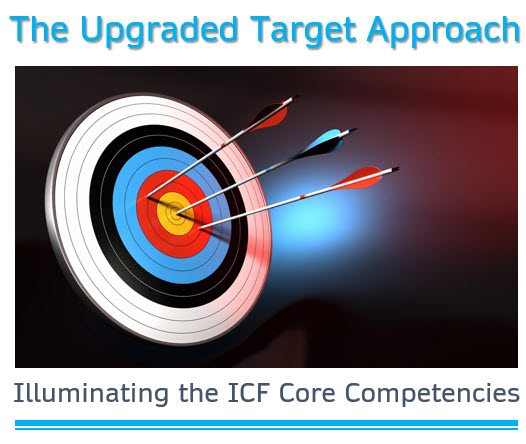 In The Upgraded Target Approach to the ICF Core Competencies, I refer to Competency 1 (Demonstrates Ethical Practice) and Competency Core 5 (Maintains Presence) as being “Target” competencies, because like an Archer, we need to ‘hit’ theses competencies in every coaching session. Competency 4 (Cultivates Trust and Safety) is an “Output” competency, because how the coach listens and responds to the client will deepen (or lessen) trust.
Here are a few of the competency sub-points to consider: how are you doing with demonstrating them in every coaching session?
- Competency 1.06: “[Coach] maintains the distinctions between coaching, consulting, psychotherapy and other support professions.”
- Competency 1.07: “[Coach] refers clients to other support professionals, as appropriate.”
- Competency 4.04: “[Coach] shows support, empathy and concern for the client.”
- Competency 4.06, “[Coach] demonstrates openness and transparency as a way to display vulnerability and build trust with the client.”
- Competency 5.04: “[Coach] manages one’s emotions to stay present with the client.”
- Competency 5.05: “[Coach] demonstrates confidence in working with strong client emotions during the coaching process.”
How to recognize when coaching may not be enough for a client
 Let’s say your coaching client arrives to a coaching session and shares what is occurring and expresses sadness and feelings of fear or anxiety. The coach takes a breath, centers themselves, and allows space for the client to express. The coach listens with openness and in presence. Once the client has stopped speaking, the coach responds in a way that lets the client know they have been ‘seen and heard.’ An empathetic example might be, “I see from your expression how much this is affecting you and it’s understandable you are feeling sad, afraid and anxious.”
The coach might further inquire such as, “What would be of best support for you in this moment?”
This is not a time to ask about session outcomes (What); instead be present to the client. Sometimes the client has experienced a disturbing event just before the coaching session. Perhaps something unexpected has just happened in their work context. Or they’ve just received some ‘shocking’ news of a personal nature. The client may not have had time to process, so give them the space to say what needs to be said, and feel what needs to be felt.
A coaching session is often the only safe place for a client to express themselves. If the client is teary or emotional, give them space to have their feelings, however expressed. Life brings every one of us unexpected challenges, no matter how much money, position or power we hold. Life happens.
There is Such Power in Being Seen and being heard. Often a client can move to the next phase of expression much more quickly if the coach has been present and responsive to the person (Who). So first, the coach allows the client to express themselves and then the coach responds in an empathetic way.
It’s best for the coach to avoid making a categorical statement that the client would be best served by therapy. Instead, partner with the client by having a conversation to clarify what might be the coaching part and what might be best served by another professional. The coach is responsible for keeping trust and safety high for the client, through what might be a vulnerable conversation.
When I have this type of conversation with my client, they may reveal to me they have a therapist, or have had a lot of therapy around this. Or that they have professional support through their spiritual community. If working for a larger organization, there are often professional resources available and they haven’t explored them (or don’t feel comfortable to do so). Always, partner with the client to explore what is best for them.
This is then the time coach and client can clarify a coaching outcome for the coaching session. Or perhaps together coach and client determine that coaching isn’t best at this time.
A skilled (MCC) coach is expected to be transparent and able to have these types of conversations with ease. For a newer or mid-level coach, it’s also very important to be able to have these conversations. And for all coaches to continue to educate themselves, so they can be of best service to their coaching client as a human being.
In closing…
 There’s a quote I have used for a very long time in my Mentor Coaching Programs; “Being heard is so close to being loved that for the average person, they are almost indistinguishable.” ~ David Augsburger.
This is profound to me, and also sad, because it means that most people do not experience being heard. Instead, they are being ignored, spoken over, interrupted, or redirected to what the other person wants to say.
Consider what your level of comfort is to have transparent conversations with a client that leave the client feeling seen, heard and cared for. As well as your comfort level with hearing and seeing yourself.
Written by Carly Anderson, MCC
Are you ready to prepare for your next ICF credential, or renew your credential?
Want to work with an experienced MCC Mentor Coach?
The Mentor Coaching Group Program is an ICF approved individual / group mentor coaching program. Approved for 30 of ICF Core Competency CCEs, including 10 hours of mentor coaching. For comparison between my MCC program, and Level 3, go to Q6 on FAQs page
Programs now open!
Visit this page for more information
 I offer a rich, experiential mentor coaching group and individual program that has many exclusive offerings for participants. You can read some testimonials from real people, FAQs, or find out more about The Mentor Coaching Program here
I offer other products including The Upgraded Target Approach: Illuminating the ICF Core Competencies. You can find more products for coaches here
I hold the Mentor Coach Specialization (MCS) designation for ACC, PCC and MCC mentor coaching, which is a requirement for all mentor coaches to have commencing January 1, 2027. I offer mentor coach education via our Mentor Coach Mastery website
I’m passionate about supporting the professionalism of coaching, which includes often engaging in ICF projects as a volunteer to continue to develop and evolve our profession. As at May 2026, I’m co-leader of the newly launched ICF Global Mentor Coaching Community of Practice. I’m also 2026 Co-Leader of the ICF Los Angeles Credentialing SIG.
A long term experienced and continuously active ICF Assessor since 2005, assessing and mentoring for all 3 credential levels. I have listened to and evaluated over 2,000 coaching session recordings between ICF assessing and my mentor coaching clients. As at June 2026, 235 coaches I’ve mentored for their MCC preparation have passed ICF MCC exam process (that I know of), as well as hundreds of coaches passed their ACC and PCC exam process. Mentor coaching clients have access to an incredible and exclusive member-only library that includes 40+ coaching recordings that have actually passed ICF MCC, PCC and ACC credential process.