
 This article has been updated on April 28 as ICF changed the original Mentor Coach Qualification (MCQ) to instead be Mentor Coach Specialization (MCS). This is a word change only. Links in this article have been updated. ~ Carly
On April 13, 2026, ICF publicly announced a new Mentor Coach Specialization (MCS) requirement, and upcoming changes to their Portfolio Assessing Systems. These changes take effect from January 1, 2027, and in full effect from April 1, 2027.
This article significantly quotes ICF released information. For more details, go to the ICF Credential Updates page
At the time of preparing this blog article (April 14, 2026), all links provided by ICF were working 🙂 At the end of this article, I provide some of my thoughts. ~ Carly
Introduction – verbatim from ICF published information 
“As the global coaching profession continues to evolve, ICF credentialing must evolve with it. That means regularly examining how we define, measure, and support coaching excellence. This commitment led us to conduct a comprehensive review of the Performance Evaluation (recorded coaching session/s) requirement.
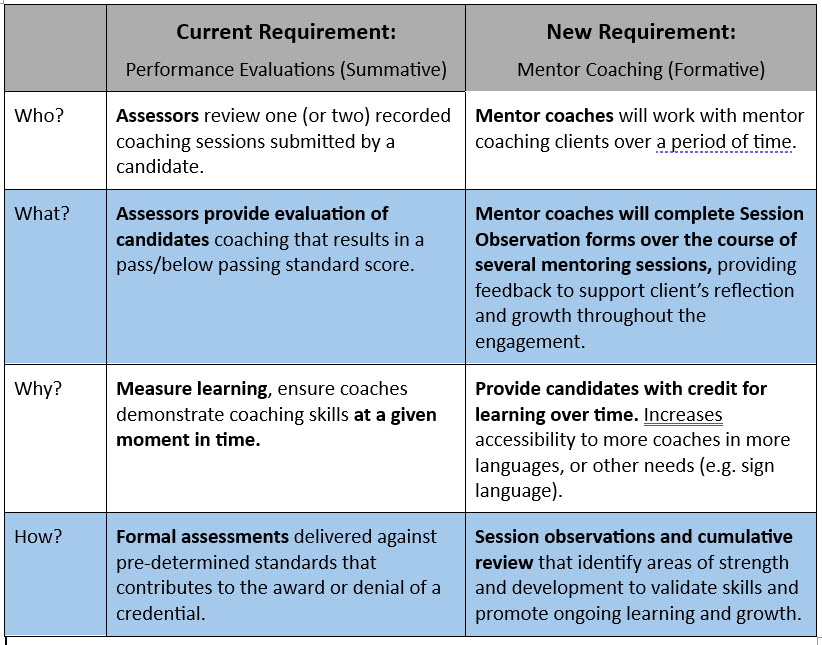
After careful review, the Performance Evaluation will no longer be a requirement for ACC and PCC Portfolio credentials effective April 1, 2027. In its place, applicants will complete an enhanced mentor coaching requirement, delivered by mentor coaches who have completed robust training and hold the new ICF Mentor Coach Specialization (MCS).
This enhanced model positions mentor coaches — qualified through robust training and the Mentor Coach Specialization (MCS) — to validate coaching competence through structured, evidence‑based evaluation within the mentor coaching process.
This change reflects how coaching competence is actually developed: through practice, feedback, and reflection over time. By strengthening mentor coaching and evolving our evaluation model, we are creating a more consistent, practice-based approach to validating coaching skills. The result is a credentialing process that is more reliable, more relevant to real coaching practice, and better aligned with the expectations of our growing global profession.”
“Beginning January 1, 2027:
- ACC and PCC candidates applying through the Portfolio path will need to complete any new mentor coaching hours with a mentor coach who has earned the MCS status, in place of the Performance Evaluation requirement.
- All credential candidates (ACC, PCC, and MCC) will need to complete the mentor coaching requirement with a mentor coach who has MCS status.
Until January 1, 2027, current requirements and processes remain in effect. And mentor coaching hours obtained prior to January 1, 2027 will still be accepted for new credential applications and for renewal of your current credential.
If submitting your credential application using the Level 1/Level 2 Path for ACC or Level 2 Path for PCC, you won’t need to do anything differently. Your coaching education program will incorporate the new mentor coaching requirements.”
Why the MCS Matters to the Profession
 Why the MCS Matters to the Profession
“For many years, mentor coaching has been a required part of the ICF credentialing process. Yet expectations for mentor coaching preparation and practice have not always been clearly defined, which has created challenges across the coaching ecosystem.
Coaches seeking mentor coaching often struggle to evaluate the qualifications and experience of mentor coaches. In a recent survey of mentor coach practitioners:
- 68% said clients struggle to understand what high-quality mentor coaching should look and feel like.
- 60% reported client confusion about the mentor coach’s role and responsibilities.
- 55% cited that clients have difficulty evaluating mentor coach qualifications.
Without clear standards, coaches may invest time and financial resources in mentor coaching experiences that fall short of expectations. At the same time, highly trained, experienced mentor coaches often struggle to differentiate their expertise in the marketplace.”
Why Is the Performance Evaluation Going Away?

“The Performance Evaluation (recorded coaching session/s) requirement has served an important purpose in the development of ICF credentialing. However, the context in which coaching operates today has changed significantly since the process was first introduced.
Coaching conversations are shaped by cultural nuance, communication style, and language context. As the profession expands across cultures, languages, and regions, evaluating coaching competence through a single recorded session presents increasing challenges. Assessing recordings — often through translated transcripts — can make it difficult to fully capture the depth of a coaching interaction and may introduce unintended barriers for candidates around the world. The current model can also present accessibility challenges for some coaches, including those who coach using sign language or other specialized communication methods.
Candidates pursuing the Portfolio path have also reported that the process can be complex, time-consuming, and costly, creating unintended hurdles to credential attainment. To better address these realities, ICF worked closely with mentor coaches, assessors, educators, and certification experts to explore new approaches aligned with modern certification practices. The result is a shift from a single, high-stakes performance assessment to a formative evaluation model.”
The MCC credential requirement to submit two performance evaluations (two recorded coaching sessions) with your MCC application remain as is. I obtained the following shareable statement from an ICF person, “We are not making changes to the MCC process at this time, as it involves additional nuances that warrant separate consideration. A formal review of the process for potential changes will begin in 2027.”
Moving from Performance Evaluation to Observed Sessions
ICF Mentor Coach Specialization (MCS)
“The MCS establishes a globally recognized benchmark for mentor coaching preparation and practice, helping coaches confidently identify qualified professionals who meet ICF expectations for quality and integrity. For mentor coaches, the MCS offers clear recognition of the expertise required for this work.” For more on the MCS visit this ICF webpage
ICF Coaching Supervisor Specialization (CSS)
Along with the MCS, ICF is creating the Coaching Supervisor Specialization (CSS). For more on the CSS, visit this ICF webpage
The ICF Credentialing Exams
The credentialing exams will continue to be required when applying for a first or next credential.
For information on the ACC Credential Exam, visit this webpage
For information on the PCC and MCC Credential Exam, visit this webpage
ICF Resources
If you have any questions about your specific situation email support@coachingfederation.org
Keep checking the ICF Credential Updates page for latest information as it is publicly released
Closing thoughts from Carly…
 These changes represent a significant shift in how ICF validates core competency skill demonstration for ACC and PCC credential applicants. The requirement for all mentor coaches to formalize their training as ACC, PCC and MCC mentor coaches seems like a good direction, to ensure a more consistent understanding and delivery of what ICF considers to be a proficient mentor coach.
ICF released their Mentor Coaching Competencies in September 2024, which provide clear understanding of what needs to be demonstrated to achieve the MCS designation.
I’ve been a mentor coach aligned with the ICF Core Competencies since 2013, currently filling Group #85 MCC mentor coaching program. This includes group and individual mentor coaching. I’m aware of the new upcoming required format for mentor coaching, and to be honest, it’s what I’ve been providing to my mentor coaching clients for the past 10 years. I provide robust evidence for each competency behavior, along with clear strength and development opportunities.
There is a new additional form required to be completed by the mentor coach. While the coach being mentored needs to be aware of upcoming changes so they ensure they are working with a Qualified Mentor Coach (ICF MCS), the majority of the requirement lies with mentor coaches to up-level their mentor coaching presence, approach and know how to provide robust written core competency and credential-specific feedback that includes strengths and development opportunities.
I’ll share more in future months as information becomes available.
Are you ready to prepare for your next ICF credential, or renew your credential?
Want to work with an experienced MCC Mentor Coach?
The Mentor Coaching Group Program is an ICF approved individual / group mentor coaching program. Approved for 30 of ICF Core Competency CCEs, including 10 hours of mentor coaching. For comparison between my MCC program, and Level 3, go to Q6 on FAQs page
Programs now open!
Visit this page for more information
 I offer a rich, experiential mentor coaching group and individual program that has many exclusive offerings for participants. You can read some testimonials from real people, FAQs, or find out more about The Mentor Coaching Program here
I offer other products including The Upgraded Target Approach: Illuminating the ICF Core Competencies. You can find more products for coaches here
I hold the Mentor Coach Specialization (MCS) designation for ACC, PCC and MCC mentor coaching, which is a requirement for all mentor coaches to have commencing January 1, 2027. I offer mentor coach education via our Mentor Coach Mastery website
I’m passionate about supporting the professionalism of coaching, which includes often engaging in ICF projects as a volunteer to continue to develop and evolve our profession. As at May 2026, I’m co-leader of the newly launched ICF Global Mentor Coaching Community of Practice. I’m also 2026 Co-Leader of the ICF Los Angeles Credentialing SIG.
A long term experienced and continuously active ICF Assessor since 2005, assessing and mentoring for all 3 credential levels. I have listened to and evaluated over 2,000 coaching session recordings between ICF assessing and my mentor coaching clients. As at June 2026, 235 coaches I’ve mentored for their MCC preparation have passed ICF MCC exam process (that I know of), as well as hundreds of coaches passed their ACC and PCC exam process. Mentor coaching clients have access to an incredible and exclusive member-only library that includes 40+ coaching recordings that have actually passed ICF MCC, PCC and ACC credential process.