
 As part of the ICF Credential application process, every coach applicant needs to pass a written knowledge exam about coaching. For ACC applicants, the written exam is known and the “ACC Credential Exam” and for PCC and MCC applicants has been known as the “ICF Credentialing Exam” (and previously known as the Coach Knowledge Assessment).
On November 10, 2026, ICF released their latest version of the written exam for PCC and MCC credential applications updated to align with the 2025 update of the Core Competencies and Code of Ethics and changed the name to the “PCC-MCC Exam.”
This article is about the PCC-MCC Exam and is based on ICF source information from this page
You can find information about the ACC Credential Exam by visiting this article I wrote and have now updated or by going to this ICF page about the ACC exam.
For latest ICF Credential Updates, visit this page
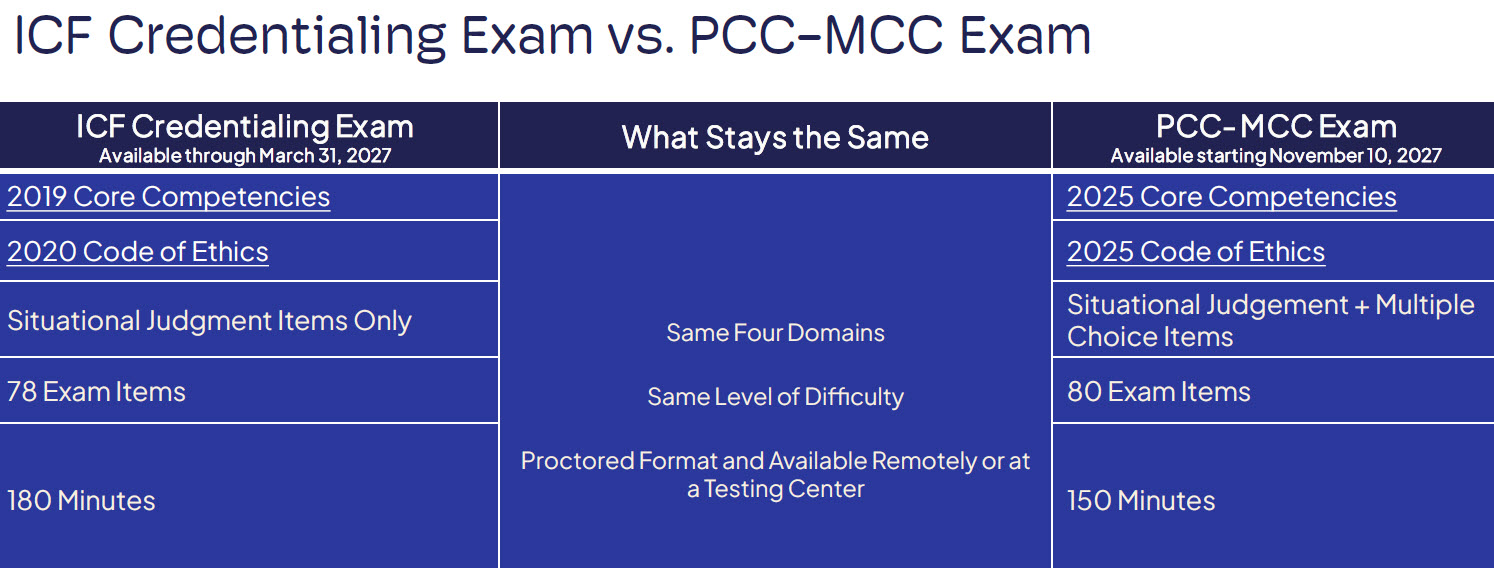
This table provided by ICF shows the difference between the “old” Credentialing Exam and the new PCC-MCC Exam
What is the purpose of the written exam?
Coaching professionals make real-time decisions to support clients’ needs during coaching sessions. While the ACC Credential Exam focuses primarily on testing knowledge, the PCC-MCC Exam uses both knowledge-based questions and situational judgment questions to evaluate how a coach makes judgments and decisions in real-world coaching scenarios – reflecting the critical decision-making skills that are key to being an experienced and effective coach.
 Languages offered
 Languages offered
The exam is offered in 16 languages, with a list of languages offered by scrolling down the ICF source page quoted at the beginning of this article.
For other languages: if the applicant resides in a non-English speaking country and the exam is not being offered in their primary language, the applicant will receive an automatic time extension of 60 minutes. The applicant may also request language supports such as bilingual translation dictionaries or translation services (for an additional fee).
Exam Format
There are a total of 80 items consisting of 44 situational judgment questions and 36 knowledge-based questions. Total Exam Time is 150 minutes, including an optional 10-minute break midway. You’ll need to submit your PCC or MCC credential application and once approved, ICF will notify your eligibility to take the PCC-MCC exam.
This is a proctored, computer-based exam available in-person at a Pearson VUE testing center or online through Pearson’s VUE remote testing platform.
Passing Score
An applicant receives points based on ability to correctly identify the best and worst actions in each situational judgment scenario. There are no penalties for incorrect answers — so be sure to answer all questions as each answer will be awarded points. Similar to other standardized testing, a scaled scoring system is used ranging from 200 to 600. A score of 460 is required to pass (77%).
What is a Knowledge-based question?

A question is posed to assess understanding of the ICF Definition of Coaching, ICF Code of Ethics, and the ICF Core Competencies. Four possible answers are given per question, with only one correct answer. Be sure to answer every question as there is no penalty for an incorrect answer.
What is a Situational Judgment question?
A coaching scenario is presented and the applicant selects the best and worst actions from four options. The questions are designed to reflect real-world coaching situations, where more than one response may seem reasonable. The key is not to choose what you might personally do, but to determine which response is the most effective — aligned with the ICF Core Competencies and Code of Ethics — and which is the least effective. While several answers may seem reasonable, there is only one “best” and one “worst” action for each situation, as determined by seasoned coach practitioners.
Sample Exam Questions
 Sample Exam Questions
On the ICF PCC-MCC Exam page, you will find three Knowledge-based sample questions, and three Situational judgment sample questions.
Here is the first Knowledge-based sample question. You can visit the PCC-MCC Exam page to find the correct answer. Or go to bottom of this article as I’ve added it there.
Which of the following actions is considered a violation of the ICF Code of Ethics?
- Maintaining confidentiality of client information.
- Engaging in a romantic relationship with a client.
- Continuing professional development.
Here is the first Situational judgment sample question. You can visit the PCC-MCC Exam page to find the correct answer. Or go to bottom of this article as I’ve added it there.
A coach is meeting with a prospective client who is growing a new business. The coach and potential client quickly establish an easy connection. The coach is excited about the opportunity to work with the client. As the coach and client are ending their conversation, the prospective client briefly mentions the name of their new business. The coach recognizes the business, as the coach is an investor in a more established competitor business in the same community. What should the coach do?
What is the BEST action?
- Not say anything. Try to keep their role as an investor in a competing business separate from their role as a coach.
- Share that the business name sounds familiar and make a mental note to determine whether it is a competitor business later that evening.
- Share their role as investor in the competitor business only if the potential client follows up to pursue coaching with the coach.
- Share their role as an investor in a competing business and acknowledge the possibility of a conflict of interest with the client.
What is the WORST action?
- Not say anything. Try to keep their role as an investor in a competing business separate from their role as a coach.
- Share that the business name sounds familiar and make a mental note to determine whether it is a competitor business later that evening.
- Share their role as investor in the competitor business only if the potential client follows up to pursue coaching with the coach.
- Share their role as an investor in a competing business and acknowledge the possibility of a conflict of interest with the client.
PCC-MCC Exam Preparation Resources
 PCC-MCC Exam Preparation Resources
Review The Upgraded Target Approach to the Core Competencies, to understand the purpose of each, how they are different, and how they flow through a coaching session.
For ICF preparation and resource information, scroll down this ICF page.
The ICF Core Competencies (2025) and ICF Code of Ethics (2025) are the foundation of the exam and guide the decision-making process in each scenario. Review the competencies regularly to internalize them and understand how they apply in coaching situations.
ICF Core Competencies (2025) access here
ICF Core Competencies (2025) videos, access here
ICF Code of Ethics (2025) access here
To find samples of knowledge-based and situational judgment questions, go to this ICF page
Other Ways to Prepare

Engage with a mentor coach who has deep knowledge of the ICF Core Competencies at the credential level you are currently studying (PCC or MCC in this case). You can view my mentor coaching program here and ensure they have acquired the Mentor Coach Specialization (MCS)
Regularly ask for permission to record from selected coaching clients for your ongoing development purposes. Study an accurate transcript of the coaching session recording, using the PCC (or MCC) behaviors required to meet the credential standard. Reflect on your coaching sessions and decisions to understand how they align with the ICF standards.
Study and apply the PCC Minimum Skills Requirements or the MCC Minimum Skills Requirements
Participate in ICF chapter learning events online and/or in-person. For example, the ICF Los Angeles chapter offers learning events and Special Interest Groups (SIGs) that focus on core competency development, understanding of ethics, and much more. You do not need to live in the area to participate online. Check the ICF-LA website for more information. Search for other ICF chapters and see what they are offering.
In Closing…
The correct answer to Knowledge-based question is B.
The correct answer to the Situational judgment question is Best Action = D, and Worst Action = A.
I hope this information clarifies what the PCC-MCC Credential Exam is and how to prepare.
Sending you good energy for your success in confidently passing!
Prepared by Carly Anderson, MCC, MCS
Are you ready to prepare for your next ICF credential, or renew your credential?
Want to work with an experienced MCC Mentor Coach?
The Mentor Coaching Group Program is an ICF approved individual / group mentor coaching program. Approved for 30 of ICF Core Competency CCEs, including 10 hours of mentor coaching. For comparison between my MCC program, and Level 3, go to Q6 on FAQs page
Program now open!
Group #88 MCC Mentor Coaching Program commencing February 10, 2027
Visit this page for more information
 I offer a rich, experiential mentor coaching group and individual program that has many exclusive offerings for participants. You can read some testimonials from real people, FAQs, or find out more about The Mentor Coaching Program here
I offer other products including The Upgraded Target Approach: Illuminating the ICF Core Competencies. You can find more products for coaches here
I hold the Mentor Coach Specialization (MCS) designation for ACC, PCC and MCC mentor coaching, which is a requirement for all mentor coaches to have commencing January 1, 2027. I offer mentor coach education via our Mentor Coach Mastery website
I’m passionate about supporting the professionalism of coaching, which includes often engaging in ICF projects as a volunteer to continue to develop and evolve our profession. As at May 2026, I’m co-leader of the newly launched ICF Global Mentor Coaching Community of Practice. I’m also 2026 Co-Leader of the ICF Los Angeles Credentialing SIG.
A long term experienced and continuously active ICF Assessor since 2005, assessing and mentoring for all 3 credential levels. I have listened to and evaluated over 2,000 coaching session recordings between ICF assessing and my mentor coaching clients. As at June 2026, 235 coaches I’ve mentored for their MCC preparation have passed ICF MCC exam process (that I know of), as well as hundreds of coaches passed their ACC and PCC exam process. Mentor coaching clients have access to an incredible and exclusive member-only library that includes 40+ coaching recordings that have actually passed ICF MCC, PCC and ACC credential process.